Open-Source Robots: The Ultimate Guide to Robots You Can Build
Which open-source robots you can build in 2026, what they really cost by region, which work with LeRobot, and what each licence lets you do.
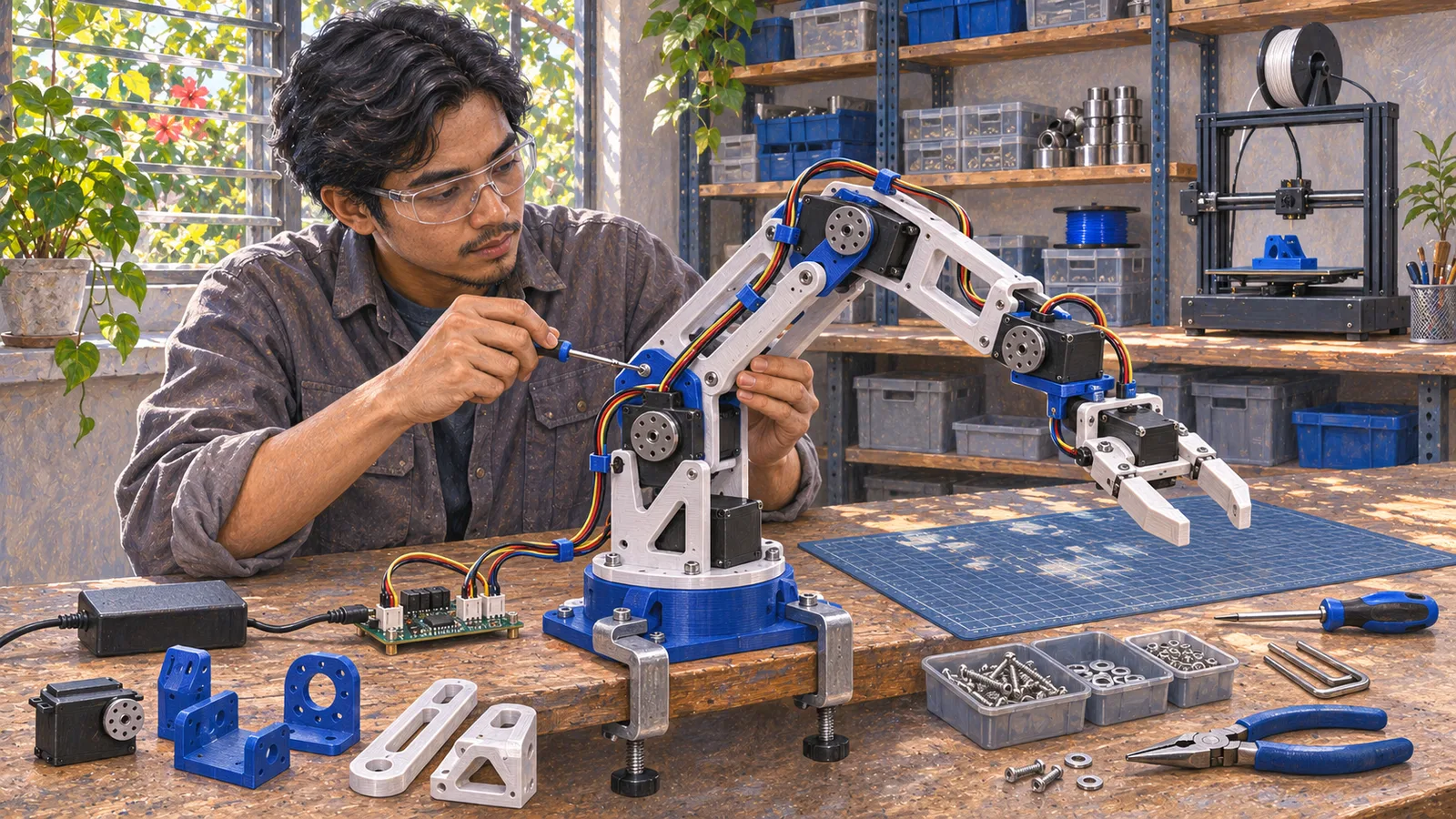
An open-source robot is one whose designer publishes everything needed to build it: CAD and print files, a parts list with prices, wiring, firmware and the software that drives it. In 2026 that covers far more than hobby toys. You can build a six-axis arm that trains AI policies for about $122 in parts, a mobile manipulator for about $480, a walking biped for under $400, and a 30-joint humanoid for under $6,000, all from files on GitHub.
The shift came from one stack. Hugging Face's LeRobot library gave low-cost arms a shared way to record demonstrations, train a policy and run it, and the SO-101 arm became its reference robot. Around it grew a family of compatible builds: the LeKiwi mobile base, the XLeRobot dual-arm cart, the Koch arm, and hands and heads from Pollen Robotics. Universities added research-grade designs such as ToddlerBot, Berkeley Humanoid Lite and Stanford Pupper v3. A directory called Robotheca now lists 486 buildable open-source robots and scores each one on how complete its files are.
This guide is the robo2u map of that field. It covers the builds worth your time in each category, what they really cost when you sum their own parts lists region by region, which ones plug into LeRobot, the actuators they share, what their licences allow, and how to pick a first build. Every cost figure links to the project's own repository, paper or store.
The take: For a first build in 2026, start with an SO-101 arm. It is the cheapest complete robot here, the best documented, and the default robot of the LeRobot stack, so every tutorial, dataset and policy works on it. Move to LeKiwi or XLeRobot when you want mobility, and to a humanoid or quadruped only when you have a specific research question and a budget in the thousands. Check the licence before you sell anything you build: several of the best designs are non-commercial.
Price any of these builds in your own currency with the Robot Build Cost Check. Companion reading: 3D printing for robotics, servo motors, imitation learning, robot teleoperation and robot simulation.
Table of contents
- Key takeaways
- What counts as an open-source robot
- The LeRobot family
- Arms
- Mobile manipulators
- Humanoids and bipeds
- Quadrupeds
- Hands and heads
- What they really cost
- Actuators: the parts that set the price
- Licences: what you are allowed to do
- How to choose your first build
- Frequently asked questions
- Sources
What counts as an open-source robot
A robot is open source when anyone can build, modify and share it from published files under a licence that allows it. In practice a buildable project publishes five things:
| Piece | What it is | Why it matters |
|---|---|---|
| CAD and print files | STEP or Onshape source plus STL or 3MF for printing | Lets you print, repair and change the frame |
| Bill of materials | Every part with quantity, price and a seller link | Tells you the real cost before you start |
| Wiring and electronics | Board choice, power, cable runs | The step most builds get stuck on |
| Firmware and software | Motor setup, calibration, control code | Turns parts into a robot that moves |
| Robot description | URDF or MJCF with meshes | Lets you simulate and train before you build |
Robotheca, a directory of buildable robots, turns those pieces into a score out of 100: parts list 20 points, 3D and CAD files 20, software 15, documentation 15, robot description 15, licences 10, simulation 5. Projects scoring 80 or more are labelled ready to build. The score is a useful filter because many repos called open source publish only some of these. MIT's Mini Cheetah release, for example, is control and simulation software only, with no build files, so you cannot build one from it.
"Open source" also gets used loosely for commercial kits with open firmware. Petoi's Bittle and Nybble run MIT-licensed OpenCat firmware, but the frame CAD is not in the repository, so they are better described as open firmware for a commercial kit.
The LeRobot family
LeRobot is Hugging Face's open-source library for real-world robot learning. It records teleoperated demonstrations, stores them as shareable datasets on the Hugging Face Hub, trains policies such as ACT and diffusion policies, and runs them on the robot. Its documentation calls the SO-101 "our flagship, low-cost arm".
That matters for buyers because a LeRobot-native robot inherits the whole toolchain: calibration scripts, dataset recording, thousands of community datasets and pretrained policies. A robot outside LeRobot may be excellent hardware, but you write more of the software yourself.
LeRobot's documentation lists native entries for SO-101, SO-100, Koch v1.1, LeKiwi, Hope Jr, Reachy 2, Unitree G1, Earth Rover Mini, OMX, OpenArm, reBot B601 and YAM, plus a page for third-party robots. Third-party hardware plugs in as a Python package: "LeRobot imports any installed package prefixed with lerobot_robot_ or lerobot_teleoperator_." XLeRobot uses that route.
| Robot | LeRobot status | Typical use |
|---|---|---|
| SO-101 | Native, flagship | First arm, tabletop imitation learning |
| Koch v1.1 | Native | Dynamixel arm, the original low-cost LeRobot arm |
| LeKiwi | Native | Mobile manipulation on a holonomic base |
| Hope Jr | Native (arm and hand) | Dexterous arm and hand research |
| XLeRobot | Plugin | Dual-arm household tasks on a cart |
| Moss v1 | Supported, being deprecated | Older STS3215 arm |
| Others in this guide | Own stacks | ROS 2, MuJoCo, Isaac Lab or custom |
For the learning side of this, see imitation learning for robots and the robot training data supply chain.
Arms
Arms are where most people start: one or two motors per joint, a fixed base, and results you can see in an afternoon.
| Arm | Maker | DOF | Actuators | Stated parts cost | Licence (hardware) |
|---|---|---|---|---|---|
| SO-101 | TheRobotStudio with Hugging Face | 6 incl. gripper | Feetech STS3215 | $121.94 one arm, $229.88 leader and follower | Apache-2.0 |
| Koch v1.1 | Alexander Koch, revised by Jess Moss | 6 incl. gripper | Dynamixel XL430 and XL330 | $199 leader, $278 follower | Apache-2.0 |
| Moss v1 | Jess Moss | 6 incl. gripper | Feetech STS3215 | $288 for two arms | Apache-2.0 |
| Thor | Ángel L.M. | 6 | Steppers, printed gears | Below €350 | CC BY-SA 4.0 |
| PAROL6 | Source Robotics | 6 | Steppers | Official kit €2,378.81 | CERN-OHL-S-2.0 |
| BCN3D Moveo | BCN3D | Not stated | Steppers | Not stated | MIT |
| Annin AR4 | Annin Robotics | 6 | Steppers, Teensy 4.1 | Check the maker's site | Software non-commercial |
SO-101 is the default. The follower arm uses six STS3215 servos with 1/345 gearing; the leader arm, which you move by hand to teleoperate, mixes 1/191, 1/345 and 1/147 gearing so it back-drives easily. A Waveshare serial bus board connects it to a laptop over USB. The repository ships URDF and MJCF files for simulation. The STS3215 comes in a 7.4V version with "a stall torque of 16.5kg.cm at 6V" and a 12V version at 30 kg.cm; the 12V arm lifts more but needs a 12V 5A supply.
Koch v1.1 came first and still works well. Its Dynamixel servos are smoother and better documented than hobby bus servos, and "the XL430 motors are almost twice as strong and are used for the first two joints". The cost is higher and the repository has not been updated since September 2024.
Thor and PAROL6 are a different class. They use stepper motors and belts or printed gearboxes, reach further and carry more (PAROL6 states 0.5 to 1 kg payload and 0.1 mm repeatability), and target people who want an industrial-style arm on a desk. Neither is part of LeRobot. PAROL6 changed its hardware licence from GPL-3.0 to CERN-OHL-S-2.0 on 4 November 2026, a reminder to check the licence on the date you build.
For programming an arm once built, see how to program a robot arm.
Mobile manipulators
| Build | Base | Arms | Compute | Stated cost |
|---|---|---|---|---|
| LeKiwi | 3-wheel holonomic (omni wheels) | One SO-101 | Raspberry Pi 5 | $482 (12V) or $499 (5V) with a leader and follower pair |
| LeKiwi wired | Same, tethered by USB | None | Your laptop | $184 |
| XLeRobot | LeKiwi-style base on a cart | Two SO-101, 2-DOF neck | Laptop, Raspberry Pi optional | About $660 Basic |
| AhaRobot (Astra) | Wheeled, aluminium profile | Two, SCARA-like | ROS 2 | $1,000 total hardware (paper) |
LeKiwi puts an SO-101 on a three-wheel Kiwi drive, so it moves in any direction without turning first. Its wheels use the same STS3215 servos as the arm, which keeps the electronics simple. The parts list comes in 5V and 12V versions plus a wired base-only version for $184 that skips the battery and onboard computer.
XLeRobot doubles the arms and adds a head camera on a two-joint neck. Its README promises "<4hrs total assembly time" and states that the cost "excludes 3D printing, tools, shipping, and taxes". Summing its own US rows gives $683.94 against the stated "~$660", so budget for the difference.
AhaRobot shows how cheap a capable bimanual platform can be ($1,000 in the paper), but its licence prohibits "ANY commercial use", and it runs on its own ROS 2 stack.
Humanoids and bipeds
| Build | Maker | DOF | Actuators | Stated cost | Hardware licence |
|---|---|---|---|---|---|
| Open Duck Mini v2 | Antoine Pirrone and community | 14 servo joints | Feetech STS3215 | "Under $400" | Apache-2.0 |
| Zeroth Bot | K-Scale Labs and community | Not stated | Not stated | BoM "starts at $350" | MIT |
| ToddlerBot 2.0 | Stanford | 30 active | Dynamixel XC330, XC430, XM430, 2XL430 | $5,727.94 essentials, "under 6,000 USD" | CC BY-NC-SA |
| Berkeley Humanoid Lite | UC Berkeley Hybrid Robotics | 22 | BLDC motors with 3D printed cycloidal gearboxes | "Under $5,000" | CC BY-SA 4.0 |
| Hope Jr | TheRobotStudio with Hugging Face | Not stated in repo | Feetech SCS0009, STS3215, Robstride 02 | Not stated in repo | No licence file |
Open Duck Mini v2 is the cheapest walking robot here: a 42 cm BDX-style droid, running a reinforcement learning policy on a Raspberry Pi Zero 2W. Its parts sheet totals €398.10 including filament, all bought in Europe. It is a fine introduction to reinforcement learning for robots because the policy trains in MuJoCo and transfers to the real robot.
ToddlerBot 2.0 is the most complete small research humanoid: 7 DOF per arm, 6 per leg, a 2-DOF neck and 2-DOF waist. The paper reports a novice assembling one "in three days, including the time for 3D printing". Motors are about $4,070 of the $5,728 essentials list, and the Jetson Orin NX 16GB alone is $955. The hardware licence is non-commercial.
Berkeley Humanoid Lite takes the other route: brushless motors with printed cycloidal gearboxes, under $5,000, with URDF, MJCF and USD descriptions. Expect to solder encoders and flash motor controllers. Its LeRobot integration page says it is coming soon.
Hope Jr is integrated with LeRobot for the arm and hand, but the repository has no licence file, so reuse rights are unclear until one is added. K-Scale's K-Bot was published under CERN-OHL-S but the company reportedly wound down in November 2025, and the repository was last updated that month.
For the hardware behind full-size humanoids, see humanoid robot hardware.
Quadrupeds
| Build | DOF | Actuators | Stated cost | Licence |
|---|---|---|---|---|
| Stanford Pupper v3 | 12 | Steadywin GIM4305 brushless, 10:1 planetary | About $2,000 | Software GPL-3.0, description MIT |
| Solo-12 (ODRI) | 12 | Brushless actuator modules | Not stated | BSD-3-Clause |
| Petoi Bittle / Nybble | 9 / 11 | Petoi servos | Sold as kits | Firmware MIT |
| MIT Mini Cheetah | Software only | n/a | n/a | Software MIT |
Pupper v3 is the practical choice: 12 brushless joints, a Raspberry Pi 5, a MuJoCo description and a documented build "for about $2000". It teaches the same control ideas as commercial robot dogs at a fraction of the price. Solo-12 is research hardware from the Open Dynamic Robot Initiative, torque-controlled and BSD-licensed, but its hardware repository has not changed since 2022.
See legged and quadruped robot hardware for how these compare with commercial dogs.
Hands and heads
| Build | DOF | Actuators | Stated cost | Hardware licence |
|---|---|---|---|---|
| AmazingHand | 8 (4 fingers, 2 per finger) | Feetech SCS0009 | "Low-cost (<200€)" | CC BY 4.0 |
| LEAP Hand v1 | 16 | Dynamixel XC330 | $2,000 | CC BY-NC-SA |
| ORCA Hand v2 | 17, tendon driven | Feetech or Dynamixel | Material cost below 2,000 CHF | CC BY 4.0 |
| Reachy Mini | 9 motors (6-DOF head, body, 2 antennas) | Dynamixel XL330 | $399 Lite, $499 Wireless kit | CC BY-NC-SA |
AmazingHand from Pollen Robotics is the cheap entry: eight micro servos, a parallel finger mechanism, €116.89 for the mechanics plus a controller. LEAP Hand and ORCA Hand are research hands with 16 and 17 joints; ORCA's CC BY 4.0 licence allows commercial use, and the project now sits inside a company, ORCA Dexterity. Reachy Mini is sold as a kit that takes "2 to 3 hours" to assemble; its hardware files are published under a non-commercial licence.
For picking an end effector for a real task, see end effectors and grippers.
What they really cost
We summed each project's own parts list, region by region, in the Robot Build Cost Check. Prices are exactly as written upstream; conversions use the ECB reference rates of 16 November 2026.
| Build | Cheapest region | Parts, that region | In USD | Motors |
|---|---|---|---|---|
| AmazingHand | China | ¥522.90 | $78 | 8 |
| SO-101 follower arm | China | ¥682.23 | $102 | 6 |
| LeKiwi wired base | China | ¥963.90 | $145 | 3 |
| SO-101 leader and follower | China | ¥1,354.76 | $203 | 12 |
| Koch v1.1 leader | US | $199 | $199 | 6 |
| Koch v1.1 follower | US | $278 | $278 | 6 |
| LeKiwi 5V with arms | China | ¥2,829 | $424 | 15 |
| LeKiwi 12V with arms | China | ¥2,890.80 | $434 | 15 |
| Open Duck Mini v2 | Europe | €398.10 | $438 | 16 |
| XLeRobot Basic | China | ¥3,912.20 | $587 | 17 |
| ToddlerBot 2.0 | US | $5,727.94 | $5,728 | 36 |
Three patterns stand out.
China lists are cheapest for Feetech builds. The STS3215 servo is ¥97.72 on Taobao in the SO-101 list against $13.89 in the US list, and the whole arm comes to about $102 against $122. If you can buy from Taobao or AliExpress, the same robot costs roughly 15 to 20 percent less in parts.
Stated totals and row sums disagree more often than you would expect. Koch v1.1's Japanese totals (¥6,993 and ¥15,446) are the sums of unit prices without quantities; the real sums are ¥27,343 and ¥34,487. LeKiwi 12V's European rows come to €537.65 against a stated €545.80. Always add up the rows yourself.
The hidden costs are real. Most lists exclude 3D printing, the printer, tools, shipping and tax. A single arm needs roughly half a kilogram of PLA; a mobile base more. Plan 10 to 25 percent on top for shipping and import tax on a small multi-seller order.
Actuators: the parts that set the price
Motors are the largest line on almost every list, and the actuator family decides the robot's character.
| Family | Examples | Typical builds | Strengths | Limits |
|---|---|---|---|---|
| Serial bus servos | Feetech STS3215, SCS0009 | SO-101, LeKiwi, XLeRobot, Open Duck, AmazingHand | Cheap, daisy-chained, position feedback | Plastic gears, modest torque, little torque control |
| Smart servos | Dynamixel XL330, XL430, XC330, XM430 | Koch, ToddlerBot, LEAP Hand, Reachy Mini | Mature SDK, current control, reliable | Two to five times the price |
| Steppers with gearing | NEMA 17 and 23 with belts or printed gears | Thor, PAROL6, AR4, Moveo | Precise, strong for the cost | Heavy, need drivers, no back-drive |
| Brushless with low-ratio gearbox | Steadywin GIM4305, MAD M6C12 with cycloidal drive | Pupper v3, Berkeley Humanoid Lite | Torque control, back-drivable, dynamic motion | Motor controllers, encoders, tuning |
Bus servos are why a $100 arm exists: six of them, one board and a USB cable. Brushless actuators are why a $2,000 quadruped can trot and recover from a push. For the theory behind each, see servo motors, stepper motors, BLDC motors and gearboxes.
Licences: what you are allowed to do
| Licence | Builds here | Can you sell what you build? | Must you share changes? |
|---|---|---|---|
| Apache-2.0 / MIT / BSD | SO-101, Koch, LeKiwi, XLeRobot, Open Duck, Zeroth Bot, Solo-12 | Yes | No |
| CC BY 4.0 | AmazingHand, ORCA Hand | Yes, with credit | No |
| CC BY-SA 4.0 | Thor, Berkeley Humanoid Lite | Yes, with credit | Yes, under the same licence |
| CERN-OHL-S-2.0 | PAROL6, K-Bot | Yes | Yes, strongly reciprocal |
| CC BY-NC-SA | ToddlerBot, LEAP Hand, Reachy Mini | No | Yes |
| GPL-3.0 with added no-commercial terms | AhaRobot | No | Yes |
| None | Hope Jr | Unclear | Unclear |
The CERN Open Hardware Licence comes in three strengths: strongly reciprocal (S), weakly reciprocal (W) and permissive (P). It was written for hardware. Creative Commons, by contrast, says on its own FAQ that "the only categories of works for which CC does not recommend its licenses are computer software and hardware", yet several research robots use CC licences anyway.
Non-commercial means "not primarily intended for or directed towards commercial advantage or monetary compensation". Building a ToddlerBot for your lab is fine; selling ToddlerBots, or a product built on its design, is not. A repository with no licence gives you no reuse rights by default, whatever its name says.
How to choose your first build
| If you want to | Build | Budget (parts) |
|---|---|---|
| Learn robot learning and LeRobot | SO-101 leader and follower | About $200 to $230 |
| Try a cheaper single arm first | SO-101 follower, teleoperate in simulation or with a keyboard | About $100 to $122 |
| Add mobility | LeKiwi, or the wired base if you have a laptop | $184 to $500 |
| Two-handed household tasks | XLeRobot | About $660 to $690 |
| Walking and reinforcement learning | Open Duck Mini v2 | About €400 |
| A real quadruped | Stanford Pupper v3 | About $2,000 |
| A research humanoid | ToddlerBot 2.0 or Berkeley Humanoid Lite | $5,000 to $6,000 |
| Dexterous manipulation | AmazingHand, then LEAP or ORCA | €130 to $2,000 |
A short checklist before you order:
- Read the parts list end to end and sum it for your region with the Robot Build Cost Check.
- Check the voltage version. SO-101 and LeKiwi come in 7.4V/5V and 12V builds with different servos and power supplies.
- Price the printing. If you have no printer, add a print service or a printer; see how to choose a 3D printer.
- Check software support for what you want to do: LeRobot, ROS 2 or the project's own stack.
- Read the licence if you might ever sell, teach a paid course with, or build a product on the robot.
- Look at the last commit date. An active repo fixes the problems you will hit.
Frequently asked questions
What is the cheapest open-source robot arm to build?
The SO-101 follower arm. Its own parts list totals $121.94 in the US and ¥682.23 in China (about $102), excluding 3D printing. A leader and follower pair for teleoperation is $229.88 in the US.
Is SO-101 better than Koch v1.1?
For most people, yes. SO-101 is cheaper, actively maintained and LeRobot's flagship arm. Koch v1.1 uses smoother Dynamixel servos and is still supported by LeRobot, but costs more and its repository was last updated in September 2024.
Do I need a 3D printer?
For most builds here, yes, or access to a print service. The parts lists usually exclude printed parts. An arm needs roughly half a kilogram of PLA; humanoids and mobile bases need several times that.
Can I sell robots I build from these designs?
It depends on the licence. Apache-2.0, MIT, BSD, CC BY and CERN-OHL designs allow commercial use. ToddlerBot, LEAP Hand and Reachy Mini hardware are non-commercial, AhaRobot prohibits commercial use, and a repository without a licence grants no reuse rights.
Which open-source humanoid is easiest to build?
Open Duck Mini v2 is the easiest walking robot, at under $400 with serial bus servos. Among full humanoids, ToddlerBot 2.0 has the most complete documentation; its paper reports a novice finishing one in three days.
What is LeRobot?
Hugging Face's open-source library for real-world robot learning. It records demonstrations, shares datasets on the Hugging Face Hub, trains policies and runs them on robots such as SO-101, Koch v1.1 and LeKiwi.
Where can I find more open-source robots?
Robotheca lists 486 buildable open-source robots with a buildability score, and LeRobot's documentation lists the robots it supports natively and through plugins.
Sources
- TheRobotStudio, SO-ARM100 repository (SO-101 parts lists)
- Hugging Face, LeRobot SO-101 documentation
- Hugging Face, LeRobot documentation home
- Hugging Face, LeRobot third-party robots
- Jess Moss, Koch v1.1 repository
- Alexander Koch, low_cost_robot repository
- Jess Moss, Moss robot arms repository
- Ángel L.M., Thor repository
- Source Robotics, PAROL6 repository
- BCN3D, Moveo repository
- Annin Robotics, AR4 HMI repository
- SIGRobotics-UIUC, LeKiwi bill of materials
- Vector-Wangel, XLeRobot repository
- AhaRobot, arXiv 2503.10070 and Astra hardware repository
- Antoine Pirrone, Open Duck Mini repository
- K-Scale Labs, Zeroth Bot repository and K-Bot repository
- Shi et al., ToddlerBot, arXiv 2502.00893, project site and repository
- Chi et al., Berkeley Humanoid Lite, arXiv 2504.17249 and repository
- TheRobotStudio, HOPEJr repository
- Stanford Pupper, Pupper v3 documentation and tech specs
- Open Dynamic Robot Initiative, actuator hardware repository
- Petoi, OpenCat repository
- MIT Biomimetic Robotics Lab, Cheetah-Software
- Pollen Robotics, AmazingHand repository
- Shaw, Agarwal and Pathak, LEAP Hand, arXiv 2309.06440 and API repository
- ORCA, ORCA Hand, arXiv 2504.04259 and hardware repository
- Hugging Face, Reachy Mini launch post and repository
- Robotheca, home and buildability score
- CERN, CERN Open Hardware Licence
- Creative Commons, BY-NC-SA 4.0 legal code and FAQ
- European Central Bank, euro reference exchange rates
More in Robot Types · All guides by topic
Related guides
- AI CAD and Text-to-CAD: The Ultimate Guide to Vibe Manufacturing
- Robot ROI and Cost per Hour: Total Cost of Ownership, Payback and the Human Wage Comparison
- 3D Rotations and Coordinate Frames for Robotics: Quaternions, Euler Angles and Every Convention
- Post-Quantum Security for Robots and Drones: Firmware Signing, Fleet Links and Migration
- Who Records Robot Training Data, Where, and for How Much
- Robot Networking: EtherCAT, TSN & Fieldbus
