AI CAD and Text-to-CAD: The Ultimate Guide to Vibe Manufacturing
Describe a part, get a STEP file, order it cut or printed. How AI CAD works in 2026, which tools output real geometry, and where it still fails.
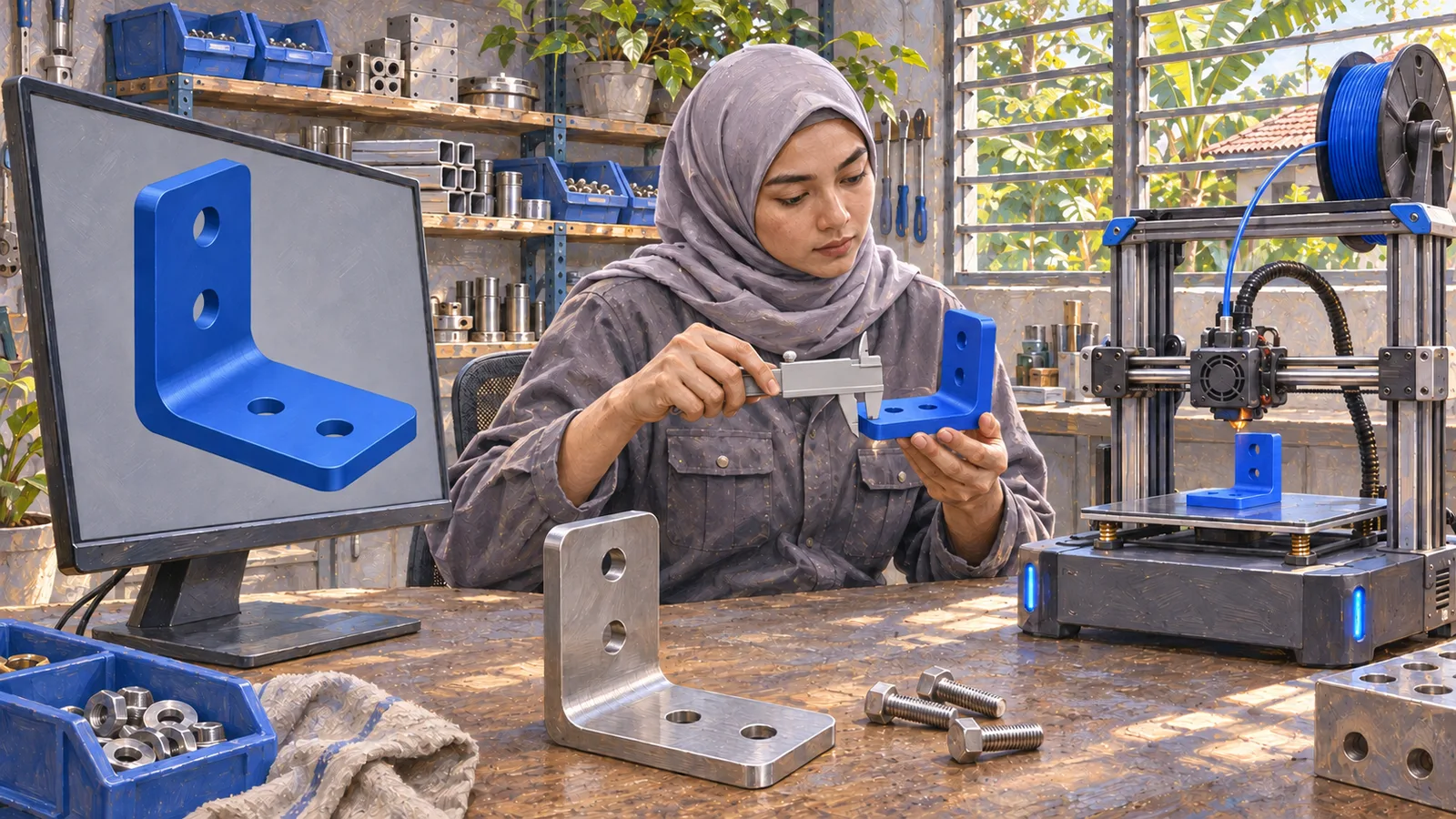
AI CAD, or text-to-CAD, turns a plain-language description of a part into a 3D model you can manufacture. "Vibe manufacturing" is the 2026 name for the full loop: describe the part to an AI, let it write the CAD, then send the file to a laser cutter, a PCB fab or a 3D printer. It works well for brackets, enclosures, plates and simple robot parts. Accuracy drops sharply as parts get complex, so every dimension that matters still needs a check before you pay for it.
In November 2026 Business Insider ran a story about people building physical things this way. A real estate developer in Michigan described a steel bracket for his camper out loud. A chatbot drew it, exported a DXF, filled in the SendCutSend order form and paid $156. Ten days later the part arrived and fit. A London student turned his own MRI scan into a printable brain. An IT worker near Paris had one model design a children's toy and a second model critique it, then ordered ten units from JLCPCB for about 500 euros. The reporter called it vibe manufacturing, after vibe coding, and the term spread within days.
The term is new. The tools are older and better known by duller names: text-to-CAD, AI CAD, code-CAD, generative design. Zoo shipped a text-to-CAD alpha in December 2023. CadQuery and OpenSCAD have let people script solid models for over a decade. What changed in 2026 is that general-purpose models got good enough at writing CAD code, and fabrication services got easy enough to order from, that a non-engineer can close the loop from idea to doorstep without opening a traditional CAD package. The same story also carries the warning. One of the builders spent about $2,000 on parts that came back wrong while the models were still building bad geometry on top of bad geometry.
This guide is the robo2u reference for that loop. It explains how prompt-to-part actually works, the difference between tools that produce editable engineering geometry and tools that produce pretty meshes, the 2026 tool landscape with funding and outputs, what the research benchmarks say about accuracy, which fabricators accept which files, and a checklist that stops a wrong part before you pay for it. The examples lean toward robotics: brackets, motor mounts, gripper fingers, sensor housings and small enclosures.
The take: Vibe manufacturing is real for simple parts and early prototypes. The workflow that works has the AI write parametric CAD code (CadQuery, build123d, KCL or OpenSCAD), exports STEP or DXF, and puts a human check on every critical dimension before the order. Mesh-only generators are for looks. Benchmarks published in 2026 show invalid-geometry rates climbing from roughly 15 percent on easy prompts to 70 percent or more on hard ones, so treat the AI as a fast junior drafter and keep engineering judgment, tolerances and safety-critical parts in human hands.
Companion reading: 3D printing for robotics, how to choose a 3D printer, materials for robotics, end effectors and grippers, and robot enclosures and IP ratings.
Table of contents
- Key takeaways
- What vibe manufacturing means
- How prompt-to-part works
- Geometry types: B-rep, code and mesh
- The 2026 AI CAD tool landscape
- Electronics: AI PCB design
- General chatbots and CAD connectors
- How accurate is it? The benchmarks
- Fabricators and the files they accept
- Where vibe manufacturing fails
- Robotics parts it suits, and parts it does not
- A checklist before you pay for a part
- Frequently asked questions
- Sources
What vibe manufacturing means
Vibe coding, a term Andrej Karpathy popularized in early 2025, describes building software by talking to an AI and accepting what it writes, judging the result by whether it runs. Vibe manufacturing applies the same habit to physical objects. You judge the result by whether it fits, holds and works.
The loop has four stages:
- Describe. Text, voice, a sketch, a photo or a scan. "A 3 mm steel L-bracket, 60 by 40 mm, two M6 holes on each leg, 10 mm from the edges."
- Generate. An AI produces geometry. In the better tools it writes a short program that builds the solid, so the dimensions sit in named variables.
- Check. You render it, measure it, print a test copy, or ask another model to critique it.
- Make. Upload a file to a fabricator (laser cutting, CNC, 3D printing, PCB) or slice it for your own printer.
Older terms cover parts of this. Text-to-CAD is the generate step from text. Generative design, as Autodesk and others have used it since the late 2010s, means a solver that explores shapes under load cases and constraints, a different technique that optimizes structure. Code-CAD is the practice of writing models as scripts. In 2026 search data, "AI CAD" and "text to CAD" each draw around a thousand US searches a month, while "vibe manufacturing" is still too new to register. Expect the names to blur.
How prompt-to-part works
Under the hood, almost every tool that produces usable engineering parts uses the same trick. The language model writes code, and a geometry kernel turns that code into a solid.
| Stage | What happens | Typical technology |
|---|---|---|
| Intent | You state shape, size, material, holes, mating parts | Text, voice, sketch, photo |
| Code generation | Model writes a parametric script | CadQuery, build123d, KCL, OpenSCAD |
| Kernel | Script is executed to build exact geometry | OpenCASCADE (CadQuery, build123d), Zoo's engine, CGAL/Manifold (OpenSCAD) |
| Validation | Check the solid is closed, sizes match, parts do not intersect | Execution errors, bounding box, measured features, FEA |
| Export | Write a file a machine or service accepts | STEP, STL, 3MF, DXF, Gerber |
| Fabrication | Order online or print locally | SendCutSend, JLCPCB, Xometry, a desktop printer |
The code step is why this got good quickly. Language models are trained on a lot of code, and a CAD script is code with a clear test: does it execute, and does the result measure right. Agents can run the script, read the error, look at a render and try again, the same loop that made AI coding assistants useful.
The open-source project at the center of the Business Insider story shows the full stack. text-to-cad (github.com/earthtojake/text-to-cad, MIT licence, created April 2026, over 26,000 GitHub stars by mid November 2026) packages agent skills and an MCP server around build123d and OpenCASCADE. The agent writes the model as a Python script and the kit exports STEP, STL, 3MF, GLB and DXF flat patterns. It adds KiCad PCB work with electrical and design rule checks, manufacturability checks, CalculiX stress analysis, dimensioned PDF drawings, URDF and MJCF robot description files, a checker for SendCutSend uploads and slicing to Bambu printers. That last group matters: most of the value sits in the checks around the generation step.
Rule of thumb: If you cannot see or edit the dimensions the AI used, you cannot fix the part when it comes back wrong. Prefer tools that hand you the script or a parametric feature tree.
Geometry types: B-rep, code and mesh
"3D model" covers three very different things, and the difference decides whether a part can be manufactured and revised.
| Type | What it is | File examples | Good for | Weak at |
|---|---|---|---|---|
| B-rep (boundary representation) | Exact surfaces: true circles, planes, fillets | STEP, IGES, Parasolid | CNC, sheet metal, injection molds, editing in any CAD tool | Organic sculpted shapes |
| Parametric code | A script that builds a B-rep or mesh from named values | .py (CadQuery, build123d), .kcl, .scad | Revisions, families of parts, AI generation | Freeform surfaces, very large assemblies |
| Mesh | Thousands of flat triangles approximating a surface | STL, OBJ, GLB, 3MF | 3D printing, renders, games | Precise holes, CNC, clean edits |
A mesh hole is a polygon with many sides. That prints fine. A CNC shop cannot program a clean bore from it, and changing its diameter means remodelling it. PCBWay's own guidance is blunt: STL files are not suitable for CNC machining.
This splits the 2026 tool market in two. Image-to-3D and sketch-to-3D tools aimed at designers (Vizcom, and the general "AI 3D model generator" category that draws about ten times the search volume of AI CAD) mostly output meshes. Vizcom's documentation states its exports are polygon meshes, not STEP or IGES. Engineering-focused tools (Zoo, CadQuery-based agents, Adam's CAD copilot inside Onshape and Fusion) output B-rep or parametric code. For a robot part that bolts to something, you want the second group.
The 2026 AI CAD tool landscape
Funding and launch details below come from each company's announcements or named press reports. Prices change often and most pricing pages load dynamically, so check the vendor before relying on a figure.
| Tool | Input | Output | Editable geometry? | Notes |
|---|---|---|---|---|
| Zoo (Text-to-CAD, Design Studio, Zookeeper) | Text, conversation | KCL code, B-rep, STEP, STL | Yes, KCL is the source | Text-to-CAD alpha Dec 2023; Zookeeper agent Feb 2026; $5M seed led by Venrex (Oct 2023) |
| text-to-cad (open source) | Any coding agent via skills/MCP | build123d script, STEP, STL, 3MF, DXF, URDF | Yes | MIT; 26k+ stars; includes FEA and fab checks |
| CADAM (open source, by Adam) | Text, image | OpenSCAD, STL, DXF | Yes, with parameter sliders | GPL-3.0; runs in the browser |
| Adam | Text | Works inside CADAM, Onshape and Autodesk Fusion | Yes, native features | YC W25; $4.1M seed led by TQ Ventures (Oct 2025) |
| Backflip | Scans, meshes | Parametric CAD in Fusion | Yes | Founded by ex-Markforged team; $30M Series A led by NEA and a16z (Dec 2024) |
| Vizcom | Sketch, render | Mesh (GLB, STL, OBJ, FBX, USDZ) | No | Industrial design focus; $27M Series B (Oct 2025); 700k+ designers |
| Autodesk Fusion (AutoConstrain, Autodesk Assistant, MCP) | Sketches, conversation | Native Fusion features | Yes | AutoConstrain shipped Jan 2025; Assistant and public MCPs announced Apr 2026 |
| Onshape AI Advisor (PTC) | Questions | Guidance inside Onshape | n/a | Help and troubleshooting assistant; geometry creation still being explored |
| SOLIDWORKS / 3DEXPERIENCE (Aura) | Conversation | Assistance inside the tool | n/a | Virtual companions unveiled Feb 2026 |
| Siemens NX and Solid Edge Design Copilot | Questions | Assistance inside the tool | n/a | NX June 2025, Solid Edge 2026 |
| Leo AI | Questions, design intent | Engineering answers, concepts | Varies | $9.7M seed (Sep 2025) |
The pattern is clear. Startups and open-source projects generate geometry. The big CAD vendors started with assistants that answer questions and automate sketch constraints, and in 2026 they began opening their tools to outside models through connectors and MCP servers. For a hobbyist the open-source code-CAD route costs nothing beyond the model subscription. For a team already on Fusion or Onshape, an in-tool copilot keeps the feature tree, drawings and PDM in one place.
Code-CAD libraries underneath. These are worth knowing by name because you will see them in AI output:
- OpenSCAD (GPL-2): the oldest. Constructive solid geometry in its own language. Exports mesh (STL), so it suits 3D printing best.
- CadQuery (Apache 2.0): Python on the OpenCASCADE kernel. Exact B-rep, exports STEP. Many research benchmarks use it.
- build123d (Apache 2.0): a newer Python library on OpenCASCADE with a cleaner API. The engine under the text-to-cad project.
- KCL: Zoo's CAD language, MIT licensed, built for its own geometry engine.
Electronics: AI PCB design
Many robot parts are boards as well as brackets, and AI is moving into the electronics half of the loop too.
| Tool | What it automates | Funding |
|---|---|---|
| Quilter | Physics-driven placement and routing; returns many candidate layouts; works with Altium, Cadence, KiCad, OrCAD, Xpedition | $25M Series B led by Index (Oct 2025), about $40M total |
| Flux | Browser PCB design with an AI copilot | $37M announced Feb 2026 (Series B led by 8VC plus an earlier Series A) |
| JITX | Circuit design written as code | $12M Series A led by Sequoia (2022) |
| Diode Computers | AI-assisted board design | YC S24, Series A led by a16z (2025) |
| KiCad plus MCP servers | An agent edits schematics and layouts in the free KiCad suite | Open source |
Quilter states it handles boards with roughly 100 to 1,000 components and that blind and buried vias, length matching and RF are still in development. Its headline case: layout work quoted at 428 hours took 38.5 hours of human cleanup. Read both numbers together. The AI does the routing, and a person still finishes the board.
For a hobby board (an ESP32, a few sensors, a motor driver), the realistic 2026 loop is: the model picks parts and writes the netlist, an AI router or KiCad autorouter lays it out, design rule checks run, and you review the power paths and connector pinouts by hand before ordering from JLCPCB or PCBWay. Our power electronics and motor drives guide covers the parts of a robot board where a routing mistake starts a fire.
General chatbots and CAD connectors
Most people in the Business Insider story used a general chatbot. Three developments made that possible in 2026:
- Models write better CAD code. The builders interviewed credited OpenAI's GPT-6 Astra, launched in September 2026. In early November OpenAI described two staff using it to design a prototype device (enclosure, circuit board, interface and software) in under a week, with manufacturing still needing several rounds of review. Benchmark numbers in OpenAI's launch material use their own versions of a CAD benchmark and are hard to compare with academic results, so treat them as vendor-reported.
- Connectors give chatbots real CAD tools. Anthropic's Claude for Creative Work release (April 2026) added connectors for Autodesk Fusion, Blender and SketchUp, letting Claude create and modify 3D models in those programs through conversation. Autodesk published its own Fusion MCP servers the same month.
- Community MCP servers. Open-source servers connect agents to Blender (mcp-for-blender, about 35,000 stars), FreeCAD (freecad-mcp, about 3,400) and KiCad (KiCAD-MCP-Server, about 3,400).
Google's Gemini 3 Deep Think update (February 2026) showed turning a sketch into a file for 3D printing. Google did not describe the file format or CAD output, so treat it as mesh-for-printing until stated otherwise.
The cross-check habit from the story is worth copying. Arthur Prince had one model design the toy and asked Claude to criticize the work, iterating until the two agreed before ordering. Two models catch different mistakes. Both can still miss a tolerance that only a printed part reveals.
How accurate is it? The benchmarks
Research benchmarks give a sober picture. They measure whether generated geometry is valid (it builds a closed solid at all) and whether it matches the intended shape and dimensions.
| Benchmark | Year | What it tests | Headline finding |
|---|---|---|---|
| Text2CAD (NeurIPS 2024) | 2024 | Text to CAD sequences, ~170k models | Invalid outputs 0.93% for its trained model vs 10% for the DeepCAD baseline on expert prompts |
| CADPrompt / CADCodeVerify (ICLR 2025) | 2024 | 200 prompts with expert CadQuery code | Visual self-verification cut geometry error ~7% and raised success ~5% with GPT-4 |
| CAD-Recode (ICCV 2025) | 2024 | Point cloud to CadQuery code | 92% IoU and 0.4% invalid on the DeepCAD test set |
| BenchCAD | 2026 | 17,900 verified CadQuery programs, 106 industrial part families | Models recover coarse outer shape, then swap sweeps, lofts and twists for simple extrudes |
| Text2CAD-Bench | 2026 | 600 prompts at three difficulty levels | Invalidity rises from about 15% on easy prompts to 70 to 90% on hard ones for most models |
| CADTestBench | 2026 | Executable tests including dimension checks | Best setup passed 62.5% of detailed-prompt tests; dimensions and spatial relations remain hard |
| MUSE | 2026 | Multi-part B-rep assemblies | Code that executes often still produces wrong assembly geometry |
Three lessons for anyone ordering parts:
- "It ran" is a weak test. CADTestBench and MUSE both show code that executes cleanly while missing the required dimensions or mating relationships.
- Hard features fail first. Sweeps, lofts, threads, drafts and multi-body assemblies are where models fall back to simpler shapes. A box with holes is easy. A curved duct is a gamble.
- Feedback loops help a lot. Every benchmark that let the model see a render, read an error or run a test scored higher. Agentic tools with execution and checks beat a single-shot chat answer.
Benchmarks lag the newest models by months, and vendors report higher scores on their own tests. The direction is still useful: simple parts are dependable today, and complex parts still need someone who can read a drawing.
Fabricators and the files they accept
The make step is easier than the design step. Instant-quote services price a part from the file in seconds.
| Service | Processes | Files accepted | Notes |
|---|---|---|---|
| SendCutSend | Laser, waterjet, bending, sheet metal finishing | AI, DXF, DWG, EPS, STP, STEP | No minimum quantity; free US shipping over $39; typical lead time a few business days |
| JLCPCB / JLC3DP | PCB, assembly, 3D printing, CNC | Gerber + drill (PCB); STL, STEP, OBJ, 3MF (3D printing) | Low-cost Chinese prototyping, ships worldwide |
| PCBWay | PCB, CNC, 3D printing, sheet metal | Gerber; STEP, IGES, SLDPRT, X_T for CNC; STL, OBJ, STEP for printing | States STL is unsuitable for CNC |
| Xometry | CNC, sheet, printing, molding, and more | STEP, STL, DXF, SLDPRT, IPT, X_T, 3MF and others | Marketplace of partner shops |
| Protolabs | CNC, molding, printing, sheet | STEP and native CAD | Parts in as little as one day |
| Your own printer | FDM, resin | STL, 3MF, STEP (most slicers) | Cheapest way to check fit first |
A typical robotics loop: print a PLA test part at home, adjust, export a DXF flat pattern for the sheet-metal version or a STEP for a CNC part, and order. The 3D printer buying guide covers which home machine handles which materials, and the materials guide covers whether the plastic or metal will carry the load.
Shapeways, once the default consumer print service, filed for bankruptcy in July 2024 and was relaunched by its founders under new ownership later that year. Users lost files stored with the old company, a reminder to keep your own copies of every design.
Where vibe manufacturing fails
The builders in the Business Insider story were candid about the misses, and they match what the benchmarks show.
| Failure | What it looks like | Prevention |
|---|---|---|
| Compounding errors | A wrong dimension in revision 1 carries into every later revision | Keep a written dimension list; check each revision against it, not against the last version |
| Loose or tight holes | Screw holes drawn at the thread size with no clearance; press fits with no interference | State clearance explicitly (M3 clearance = 3.2 to 3.4 mm); print a hole test coupon |
| Parts that do not mate | Two halves of an enclosure miss by a millimetre | Generate both parts from one script with shared variables |
| Simplified features | Requested sweep or fillet replaced with a plain extrude | Inspect the render from several angles; ask the model to list each feature it built |
| Mesh where you needed B-rep | STL sent to a CNC shop, quote rejected | Ask for STEP output from a code-CAD tool |
| Unmanufacturable geometry | Bend too close to a hole, wall too thin, internal sharp corner on a milled pocket | Run the fabricator's DFM check; read its design guidelines |
| Wrong material assumptions | PLA bracket near a motor softens; thin aluminium bends | State load, temperature and environment in the prompt; check with a quick FEA |
| Scope creep | A simple fixture grows into a product the AI cannot keep consistent | Freeze the requirements before generating; split into separate parts |
One builder in the story printed his answering-machine case about 15 times before the parts fitted. Another spent about $2,000 reordering metal parts while the AI repeated errors. Both eventually got working parts. Budget for iteration the way you would for any prototype, and use cheap plastic iterations before expensive metal ones.
Safety rule: Do not vibe-manufacture parts whose failure can hurt someone without independent engineering review. That includes lifting points, vehicle and trailer mounts carrying real loads, pressure vessels, guards on moving machinery and anything worn on the body. A good fit proves the geometry. Load, fatigue and failure mode need their own checks.
Robotics parts it suits, and parts it does not
| Good fit today | Needs more care | Keep with engineers |
|---|---|---|
| Sensor and camera brackets | Gearbox housings with bearing fits | Structural frames for humanoids and arms carrying payloads near people |
| Motor mounts and plates | Gripper fingers under real grip force | Safety guards and e-stop mounts |
| Electronics enclosures and lids | Snap fits and living hinges | Pressure and fluid parts |
| Cable clips, spacers, standoffs | Sheet-metal parts with many bends | Certified medical, automotive or aerospace parts |
| Jigs and fixtures for the bench | Multi-part assemblies with tolerance stacks | Anything requiring traceable material certs |
Robot builders also gain a less obvious benefit. Tools such as text-to-cad can emit URDF and MJCF robot description files from the same script that makes the parts, so the simulated robot and the built robot share dimensions. See the robot simulator guide for where those files go, and the end effectors guide for gripper design rules the AI will not know unless you tell it.
A checklist before you pay for a part
- Write the spec first. Overall size, material and thickness, every hole with size and position, what it mates with, load and temperature. Paste it into the prompt.
- Ask for code-CAD and STEP. Request a CadQuery, build123d, KCL or OpenSCAD script with dimensions as named variables.
- Read the variables. Confirm each critical value in the script matches your spec.
- Render and measure. Check the model from all sides and measure hole spacing in a viewer or slicer.
- Get a second opinion. Ask another model, or a person, to critique the design against the spec.
- Print a test part. A cheap plastic print checks fit against the real mating parts.
- Run the fabricator's checks. Upload, read the DFM warnings, and check bend and hole rules for sheet metal.
- Order one, then many. Order a single metal part before a batch.
- Save the script and the spec. Keep them in version control so the next revision starts from a known-good design.
Frequently asked questions
What is vibe manufacturing? Vibe manufacturing means designing a physical object by describing it to an AI, which generates the CAD, then sending the file to a fabricator or 3D printer. The term was popularized by a Business Insider story in November 2026, borrowing from vibe coding. It works best for simple parts and early prototypes.
What is text-to-CAD? Text-to-CAD is the generation step: an AI turns a text description into a 3D CAD model. Good text-to-CAD tools output editable parametric geometry (often a script in CadQuery, build123d, KCL or OpenSCAD) that exports to STEP. Zoo launched one of the first public text-to-CAD tools in December 2023.
Is AI CAD the same as generative design? No. Generative design is an optimization method: you set loads, constraints and materials, and a solver explores structural shapes. AI CAD and text-to-CAD use language models to build geometry from a description. Some tools combine both, but they solve different problems.
Which AI CAD tool should I use? For printable hobby parts, CADAM or a chatbot writing OpenSCAD is enough. For parts you will machine or cut, use a tool that outputs STEP, such as Zoo, the open-source text-to-cad kit with a coding agent, or an AI copilot inside Fusion or Onshape. Image-to-3D tools such as Vizcom suit concept models because they output meshes.
Can ChatGPT or Claude design a 3D printable part? Yes, for simple parts. Ask for an OpenSCAD or CadQuery script with dimensions as variables, run it, and export STL or STEP. Results improve when the model can run the code and see the result, which agent setups and CAD connectors now allow.
How accurate are AI generated CAD models? Simple prismatic parts are usually right or close. 2026 benchmarks found invalid geometry rising from roughly 15 percent on easy prompts to 70 percent or more on hard ones, and code that runs can still miss required dimensions. Measure every critical feature and print a test part before ordering metal.
What file format should I send to a fabricator? STEP for CNC machining and most 3D parts, DXF for laser-cut or waterjet flat parts, STL or 3MF for 3D printing, and Gerber with drill files for PCBs. Avoid sending STL to a CNC shop.
Can I use vibe manufacturing for a commercial product? For prototypes and early batches, yes, many people do. A product sold to the public needs design for manufacturing review, tolerance analysis, material and safety testing and often certification. AI can speed up the drafting, and people still need to do the engineering sign-off.
Will AI replace CAD engineers? It is replacing routine drafting of simple parts. The benchmarks show complex features, assemblies and tolerances remain hard for models, and the judgment about loads, failure modes and manufacturability still sits with engineers.
Sources
- Business Insider via Yahoo Tech, "Vibe coding is old news. People are 'vibe manufacturing' now." (1 Nov 2026) - the builders, costs and quotes cited throughout.
- text-to-cad on GitHub - the open-source agent kit: build123d engine, exports, checks and licence.
- Zoo, Introducing Text-to-CAD (Dec 2023) - B-rep output and STEP export.
- Zoo, Zookeeper announcement (Feb 2026) - the conversational CAD agent.
- Zoo FAQ - KCL as source of truth, STEP and STL export.
- KittyCAD (Zoo) seed round, PR Newswire (Oct 2023) - $5M seed led by Venrex.
- TechCrunch, Adam raises $4.1M (Oct 2025) - Adam funding, founders and product.
- Adam - CAD copilot across CADAM, Onshape and Fusion.
- CADAM on GitHub - open-source OpenSCAD generator, licence and exports.
- SiliconANGLE, Backflip closes $30M (Dec 2024) - Backflip funding and founders.
- Vizcom Series B announcement (Oct 2025) - funding and user count.
- Vizcom docs, 2D to 3D - mesh-only export formats.
- Autodesk Research, AutoConstrain in Fusion - AI sketch constraints.
- Autodesk News, Autodesk Assistant (Apr 2026) - assistant and public Fusion MCPs.
- PTC, Onshape AI Advisor release (Oct 2025) - scope of the Onshape assistant.
- Dassault Systemes, AI-powered virtual companions (Feb 2026) - Aura, Leo and Marie.
- Siemens, Solid Edge 2026 AI - Design Copilot rollout.
- Unite.AI, Leo AI raises $9.7M (Sep 2025) - Leo AI seed.
- Anthropic, Claude for Creative Work (Apr 2026) - Fusion, Blender and SketchUp connectors.
- Interesting Engineering, OpenAI GPT-6 hardware prototype (Nov 2026) - OpenAI's device prototype account.
- Google, Gemini 3 Deep Think (Feb 2026) - sketch to 3D-printable file demo.
- Quilter - PCB placement and routing claims and limits.
- iConnect007, Quilter Series B (Oct 2025) - funding.
- SiliconANGLE, Flux raises $37M (Feb 2026) - Flux funding.
- JITX Series A - code-based circuit design.
- a16z, Investing in Diode - Diode Series A.
- OpenSCAD, CadQuery and build123d - the code-CAD libraries and their licences.
- mcp-for-blender, freecad-mcp and KiCAD-MCP-Server - community MCP servers.
- Text2CAD, arXiv 2409.17106 - text to CAD sequences, NeurIPS 2024.
- CADCodeVerify / CADPrompt, arXiv 2410.05340 - visual verification for CAD code.
- CAD-Recode - point cloud to CadQuery code.
- BenchCAD, arXiv 2605.10865 - industrial part families.
- Text2CAD-Bench, arXiv 2605.18430 - invalidity by difficulty level.
- CADTestBench, arXiv 2605.07807 - executable tests with dimension checks.
- MUSE, arXiv 2605.28579 - multi-part assemblies.
- SendCutSend FAQ and pricing - accepted files, minimums and shipping.
- JLCPCB, Gerber and drill files in KiCad - PCB upload format.
- PCBWay rapid prototyping - processes offered.
- Xometry and Protolabs - instant-quote services and accepted formats.
- Metal AM, Shapeways returns under new management - bankruptcy and relaunch.
More in Mechanical, Transmission & Materials · All guides by topic
Related guides
- 3D Printing Robot Parts: Processes, Materials and Strength
- Open-Source Robots: The Ultimate Guide to Robots You Can Build
- Robot ROI and Cost per Hour: Total Cost of Ownership, Payback and the Human Wage Comparison
- 3D Rotations and Coordinate Frames for Robotics: Quaternions, Euler Angles and Every Convention
- Post-Quantum Security for Robots and Drones: Firmware Signing, Fleet Links and Migration
- Who Records Robot Training Data, Where, and for How Much
